
Porch Theft on CNshopper’s protection page: a delivered scan and nothing on the step
The card for a parcel that tracking calls delivered and you never held: its two conditions, its four kinds of proof, and the limits printed around it.
The two conditions printed on the card
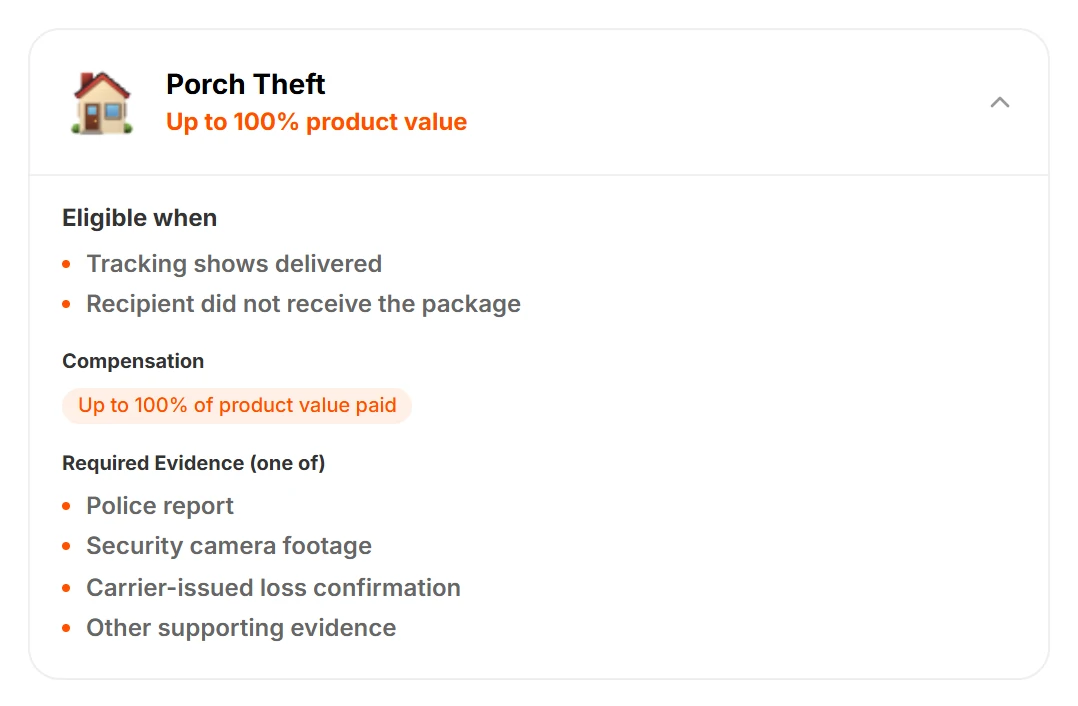
The Porch Theft card on CNshopper’s Package Protection Policy has an “Eligible when” list of two lines. Both have to be true, and they are worded from two different points of view.
“Tracking shows delivered” is the carrier’s statement. It is a scan in the carrier’s system, often with a time and sometimes with a photo or a location, and you cannot change it. “Recipient did not receive the package” is your statement, and nothing on the page says how it is tested. That gap is what the evidence list exists to fill: the reviewer has one record saying the box arrived and your word that it did not.
The card does not explain every delivery arrangement, such as signatures or a designated safe place. Do not infer cover for an unmentioned situation. Ask the claim handler how the actual carrier record and delivery circumstances are assessed.
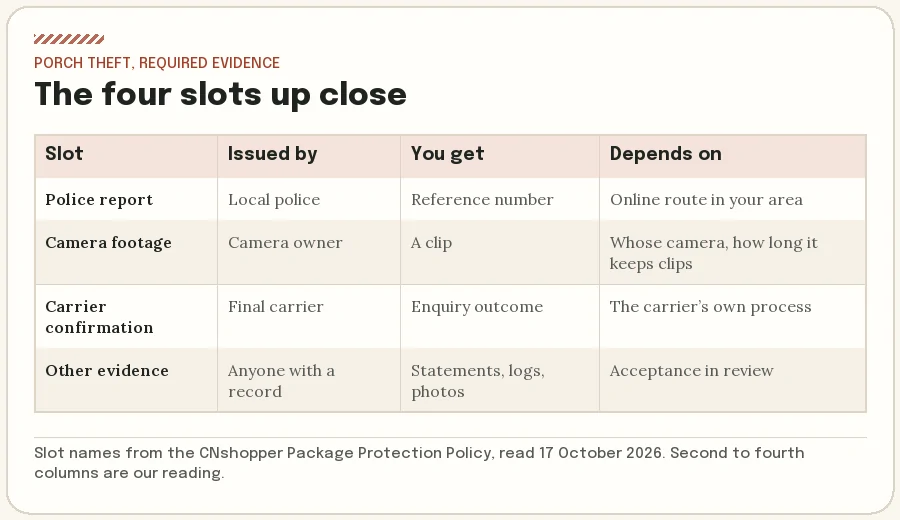
One proof out of four, and which one you can actually get
The card lists alternative evidence types. Prepare the strongest record you can obtain and ask whether it meets the claim requirements; producing one document does not by itself establish an accepted claim.
- Police reportwithin reach
- Camera footagedepends
- Carrier confirmationdepends
- Other evidencedepends
A typical setup with no camera of your own: a police report is the one slot almost every household can fill.
Police report
Police reporting routes vary by country and locality. Check the official reporting service linked on the country page for eligibility, the required details and whether a written report is issued. A reference number documents a report; its sufficiency for a claim is decided by the claim handler.
Security camera footage
Only realistic if a camera you control covers the spot. A building, locker operator or shop may have cameras, but the clip is theirs to release, and many keep recordings for a limited time. If the profile marks this slot as “depends”, that is the reason.
Carrier-issued loss confirmation
This is the outcome of the carrier’s own missing-item process. Recipients can usually open an enquiry: USPS has a missing mail search request, Canada Post an investigation request, Australia Post an online enquiry for a delivered parcel you did not receive. Whether that ends in a written confirmation of loss, and how long it takes, is up to the carrier.
Other supporting evidence
Undefined on the page. A note from a building mailroom, a neighbour’s statement, or a delivery photo that shows a different door might count. Whether it does is decided in review, so it works best alongside one of the other three.
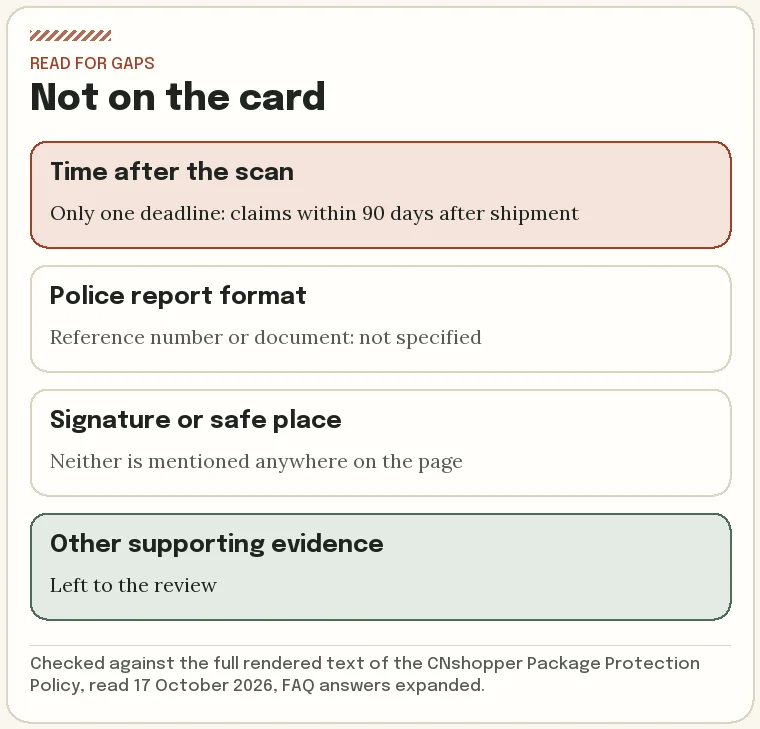
What the card leaves unsaid
Reading the card for what it omits is as useful as reading what it says. Four things are missing from the Porch Theft card and from the page around it:
- No reporting window after the scan. The only deadline on the page is the claim deadline, 90 days after shipment, not after delivery.
- No format for the police report. A reference number, a PDF, an email confirmation: the page does not say which.
- No mention of signatures or safe places. Whether a signed-for delivery or an authorised safe place changes the outcome is not addressed.
- No list of what “other supporting evidence” includes. The provider decides.
The page does state who decides: the review is done by the Shipping Protection Provider, and the provider makes the final decision on eligibility and compensation. We note that as a fact and leave it there.
Filing through the Claims Center named on the page
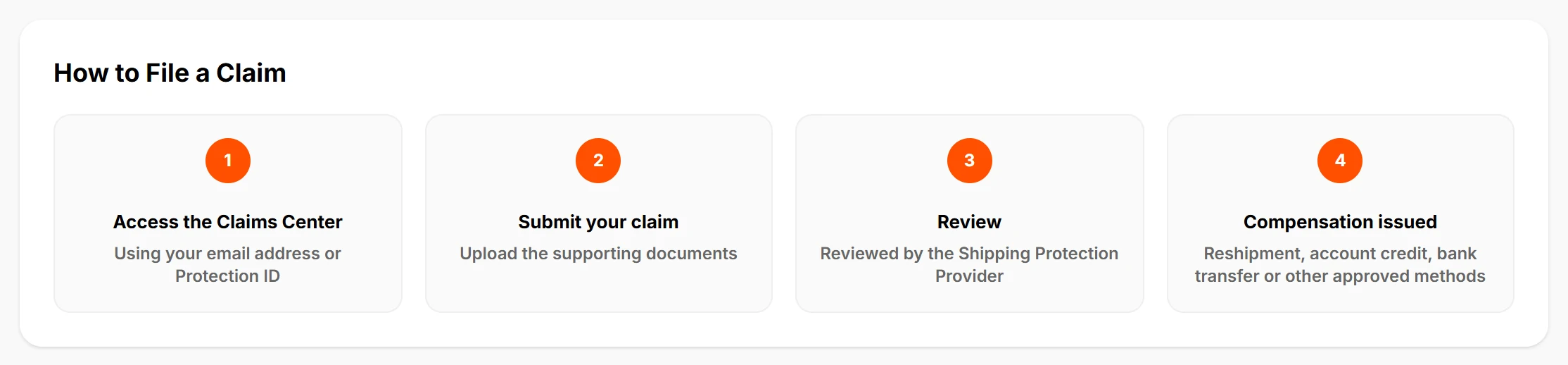
The “How to File a Claim” strip on the policy page has four steps: access the Claims Center using your email address or Protection ID, submit the claim with supporting documents, review by the Shipping Protection Provider, and compensation issued by reshipment, account credit, bank transfer or another approved method.
Two things follow from that wording. The Protection ID is something you receive when you buy protection, so keep the confirmation. And the claim is made with the provider, not inside CNshopper’s order screens, though CNshopper’s FAQ says it helps by providing order and shipment information when needed. We do not link the provider’s own site; start from CNshopper’s policy page.
The Note section adds the timing CNshopper publishes: an initial response within 24 hours, most approved claims processed within 2 business days once the documents are in, and claims submitted within 90 days after shipment. Late claims “may not be accepted”.
Exclusions that sit next to a doorstep claim
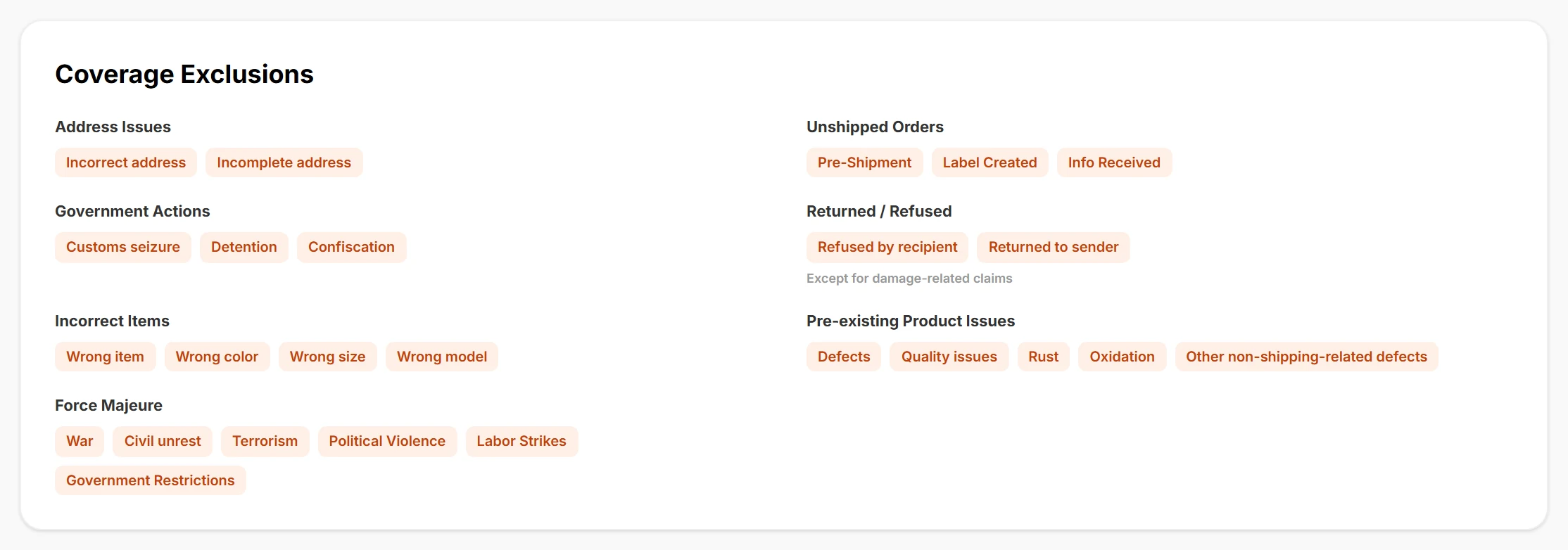
The Coverage Exclusions block applies to every card. Several entries bear directly on a parcel that shows delivered:
- Address issues: an incorrect or incomplete address is excluded.
- Unshipped orders: statuses such as pre-shipment, label created or info received are excluded, so a parcel must have actually moved.
- Returned or refused: refused by recipient and returned to sender are excluded, except for damage-related claims.
- Government actions: customs seizure, detention and confiscation are excluded.
- Force majeure: war, civil unrest, strikes and government restrictions are excluded.
None of these speaks to theft after a genuine delivery, which is why the Porch Theft card can stand at all. They do define its edges: a scan that reads delivered to the wrong address you typed is an address issue, not porch theft.
Bought per order, before the box leaves
The FAQ on the policy page answers how protection is bought: “Add it during international parcel checkout. Coverage is purchased per order and applies only to the products in that protected shipment.” It also says that once the package has shipped and coverage is active, it cannot be cancelled.
So the decision belongs to the parcel checkout screen, after QC and before freight is paid. We could not open that screen without an account, and the public setup code shows more than one protection mechanism, one of them limited to a few European lines. We therefore do not claim to know which lines can carry it. The checkout shows it for your parcel.
The Important Notice above the cards is the other fixed line: protection covers product value only, not international shipping fees, customs duties and taxes, or the protection fee.
