
Misdelivery under CNshopper’s Package Protection: the parcel reached a door, not yours
The card for a delivery scan that happened at someone else’s address, the exclusion that turns on what you typed, and the carrier records that settle it.
What the card counts as a misdelivery
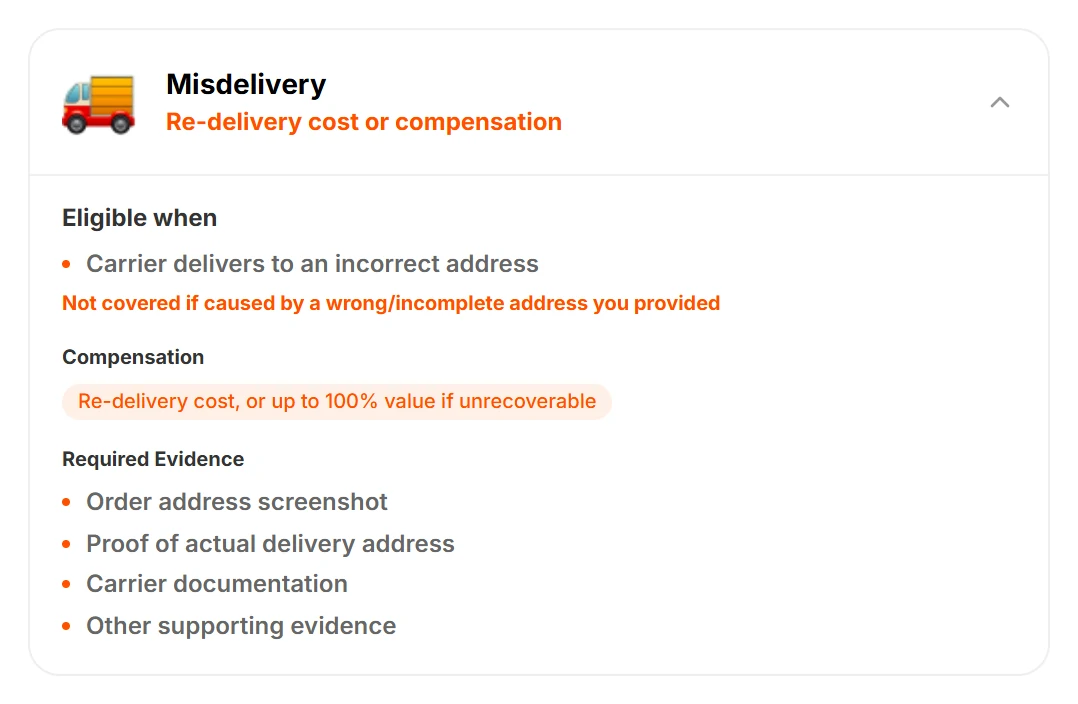
The Misdelivery card is short. It applies when the “carrier delivers to an incorrect address”, and it is “not covered if caused by a wrong/incomplete address you provided”. The remedy is described as re-delivery, or compensation if the parcel cannot be recovered.
The card therefore turns on one question that Porch Theft never asks: where did the parcel actually go? A porch theft claim says the box reached your door and vanished. A misdelivery claim says it reached somebody else’s. The tracking page often looks identical in both cases, so the proof has to show which one happened.
In the “What’s Covered?” strip the card is labelled “Re-delivery / Comp.”, which is the only card whose first answer is getting the same parcel to you rather than paying for it.
Proof the card asks for, item by item
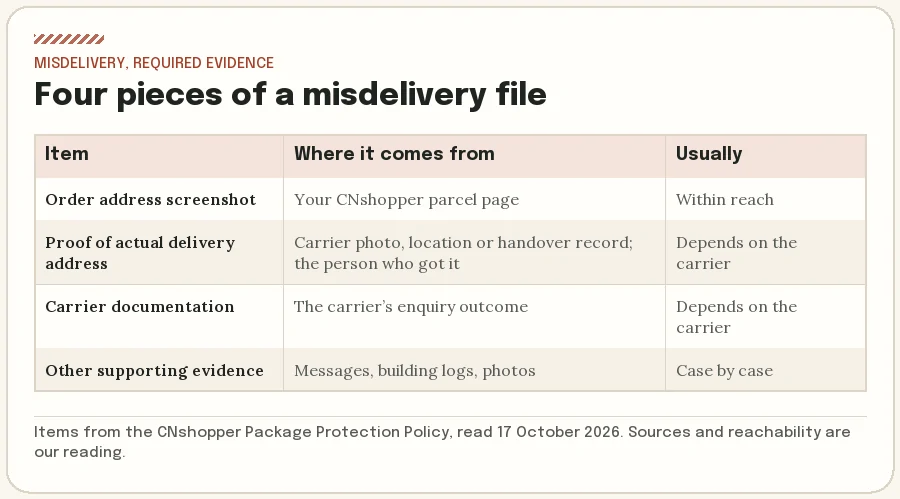
Unlike Porch Theft, the Misdelivery evidence list is not marked “one of”. It reads as a set: order address screenshot, proof of actual delivery address, carrier documentation, and other supporting evidence. Here is how each one is obtained in practice.
- Order address screenshot. The address on your CNshopper parcel. This one is always within reach, provided you take it before anything is edited.
- Proof of actual delivery address. The hard one. It usually comes from the carrier: a delivery photo of the wrong door, a GPS point, or the address recorded at handover. Sometimes a neighbour who received it is the proof.
- Carrier documentation. Whatever the carrier issues after an enquiry. In practice this and the previous item often arrive together.
- Other supporting evidence. Messages with the person who received it, a building log, or a photo of the parcel at the other address.
The middle two depend on the carrier answering you, which is why the carrier enquiry pages matter more for this card than police routes do.
Your address, the one variable you set yourself
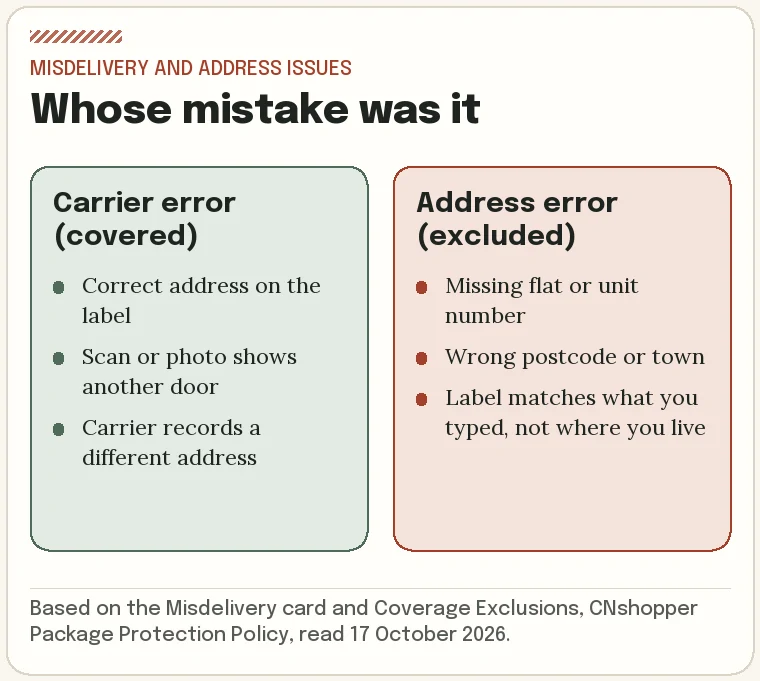
The exclusion on this card, and the Address Issues line in the general exclusions, both rest on the address you entered. An incorrect or incomplete address is outside protection. CNshopper’s Return & Refund Policy points the same way: in section 15, an incorrect or incomplete address is one of the reasons a refund may not be possible.
Flat numbers, building names and a unit letter are the usual casualties when an address is squeezed into a form designed for another country. The parcel screen shows the address that goes on the label; that screenshot is also your first piece of evidence.
If a carrier delivers to an address that matches what you typed but is not where you live, for example a duplicate street name in a nearby town, that is still your address issue on the wording of the card.
Shared buildings and look-alike doors
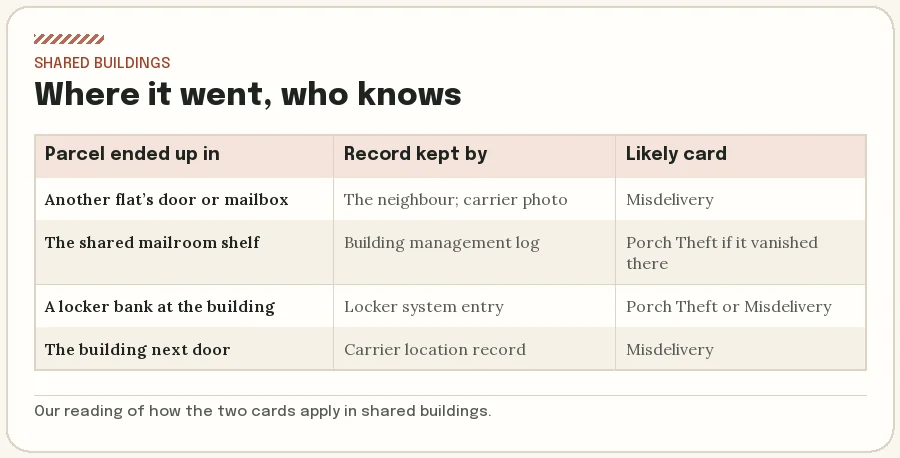
In a block of flats the line between misdelivery and theft blurs. A parcel scanned as delivered to the building may have gone into the wrong locker, the wrong mail shelf or the wrong flat. From the card’s point of view that can be a misdelivery if the carrier put it somewhere other than your address, or nothing at all if it reached the building’s shared area that your address names.
What usually decides it is a record kept by someone other than you: the building’s mailroom log, a locker system entry, a concierge’s note. Those records fall under “other supporting evidence” on both cards. Ask for them in writing while they still exist.
When the wrong door hands it back
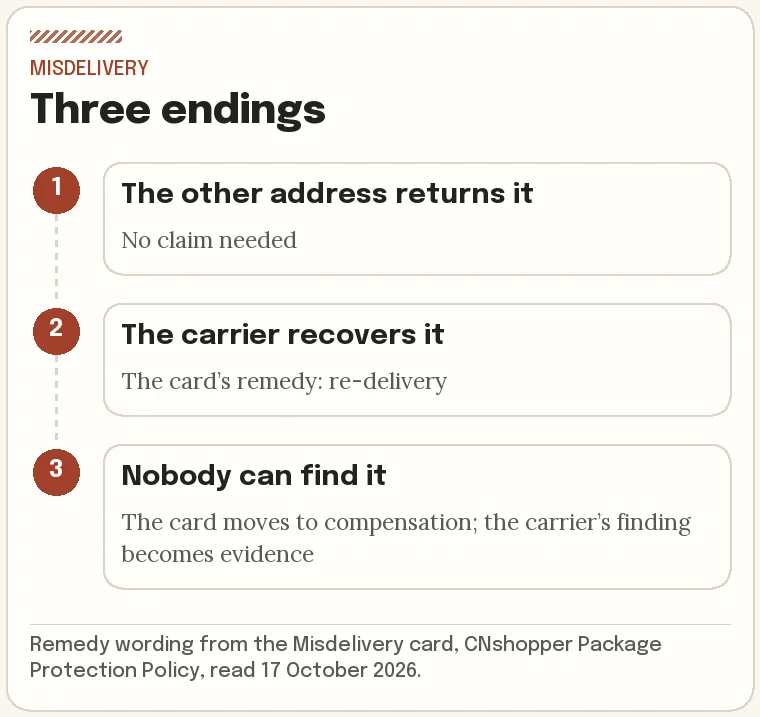
Misdelivery is the one card where the parcel may still exist. If a neighbour has it, the problem is solved without a claim. If the carrier recovers it, the card’s first remedy, re-delivery, applies. Only when it cannot be recovered does the card move to compensation.
That order matters for the evidence too. A carrier enquiry that ends in “we have retrieved it” is the end of the matter; one that ends in “we cannot locate it” is exactly the carrier documentation the card asks for.
A misdelivered parcel also tends to surface on its own. People who receive a box with someone else’s name on it often hand it back or leave it with the carrier, which is one more reason the card’s order puts re-delivery first. Note the date you asked around and who you asked; if the parcel never reappears, that note is part of the “other supporting evidence” the card leaves open.